



What Are You Looking For?
 Home
/
Home
/
Why waste space when every bridge becomes a clean energy source? Xi'an leads the way!
Dec 31, 2025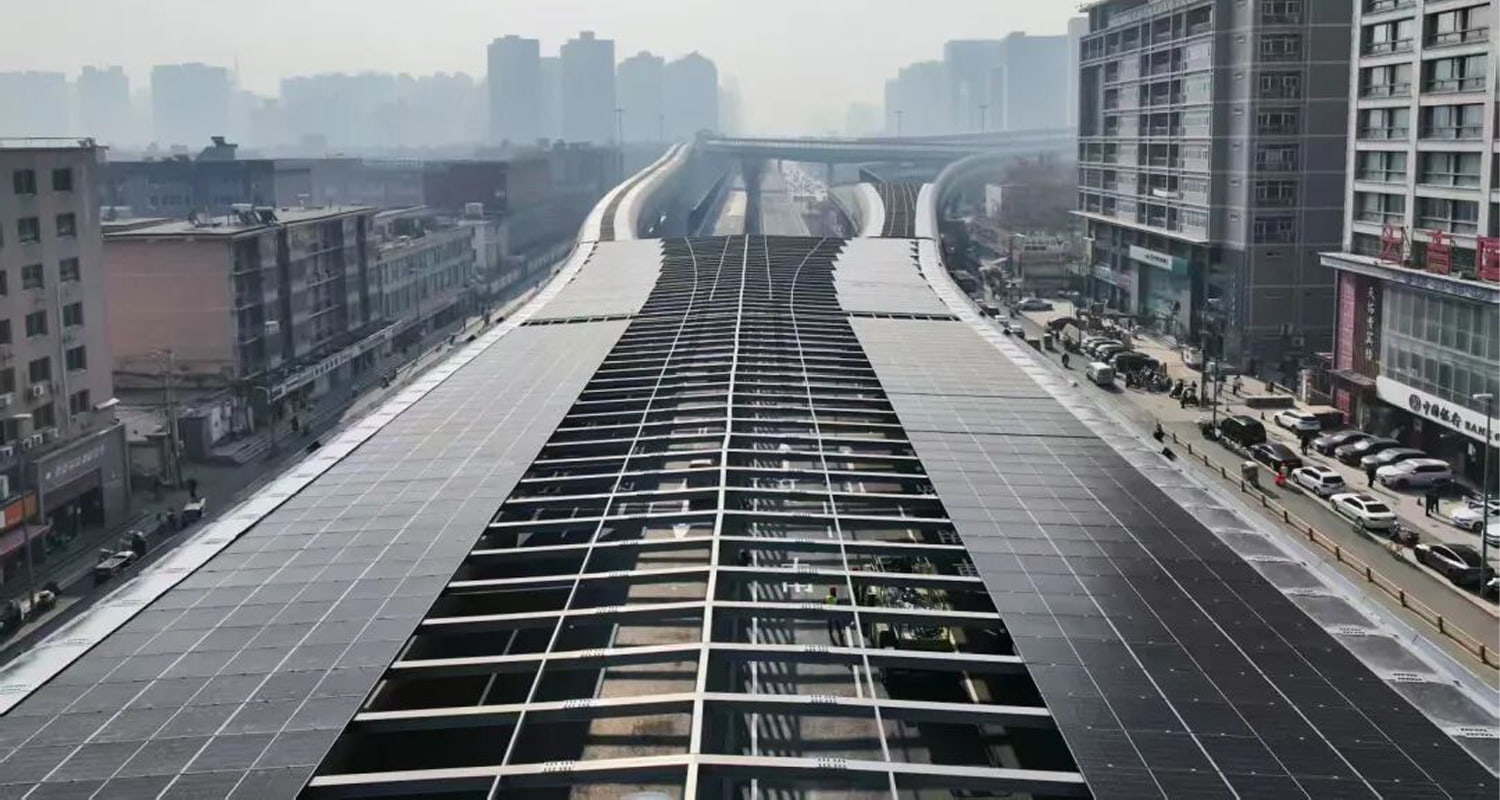
Starting at 6:00 AM on December 29th, the main bridge and ramps of the Southwest Second Ring Road Interchange officially opened to traffic. This long-standing traffic bottleneck for Xi'an residents has seen a crucial improvement, with the regional road network structure being restructured, traffic flow effectively diverted, and traffic efficiency significantly improved. A long-standing urban traffic congestion point has been cleared.
However, this opening is not just a traffic improvement.
The appearance of this "sun hat" (referring to solar panels) is not accidental.
Introducing photovoltaics into core urban traffic scenarios has always been considered a highly challenging task. The reason is not the maturity of the technology, but the extremely stringent safety requirements of road conditions. Any factor that might affect the driver's visibility or cause safety hazards is unacceptable. This is why many past "transportation + photovoltaic" projects have remained merely concepts or small-scale pilot projects.
The Xi'an project's choice of a high-traffic, densely populated elevated section of the West Second Ring Road, with its high concentration of nearby residents, itself demonstrates a high degree of confidence in safety. The LONGi Hi-MO X10 anti-glare solar panels installed on top of the sound barrier allow the photovoltaic system to integrate into the city's operation without disrupting traffic.
In terms of scale, this is not merely symbolic. The West Second Ring Road elevated highway is an eight-lane dual carriageway, approximately 685 meters long, with over 20,000 square meters of usable overhead space. The project actually installed approximately 9,600 square meters of photovoltaic panels, with an installed capacity of 2MW, generating approximately 1.95 million kWh of electricity annually and reducing carbon dioxide emissions by approximately 1,900 tons per year. Traffic flow, noise reduction, and power generation are all combined on the same elevated highway.
However, the prerequisite for this scale is that risks are addressed proactively. Glare is the first hazard that needs to be eliminated. The metal grid lines on the front of traditional photovoltaic modules can easily create specular reflections at certain angles, producing dazzling glare. This can not only affect driving safety but also lead to complaints from residents. This problem has long constrained the application of photovoltaics in traffic scenarios.
This project did not choose a reactive approach but instead changed the structure from the source of the modules. The Hi-MO X10 employs BC2.0 back-contact technology, transferring all the metal grid lines from the front of the battery to the back, eliminating the main source of reflection from a physical structure perspective. Actual measurements show a reduction of reflected light of approximately 69% compared to conventional modules. Combined with anti-glare glass and surface treatment, direct light is transformed into uniform and soft diffuse reflection, avoiding interference with the vision of drivers and residents.
Furthermore, fire safety is another crucial consideration. In recent years, numerous photovoltaic sound barrier projects have experienced fires during their initial operation. Investigations have revealed that hot spot effects are one of the primary contributing factors. When a module is partially shaded, the local temperature can rise to over 150°C within a short time, becoming a potential ignition source.
To address this risk, the Hi-MO X10 integrates 21,600 bypass diode-like structures within the module. In the event of partial shading, these diodes quickly disperse current and heat, stabilizing the operating temperature below approximately 80°C, thus fundamentally cutting off the hot spot runaway path. Meanwhile, the anti-dust design reduces dust accumulation, further lowering the probability of hot spots and improving the long-term stability of the system.
Only when the two core safety boundaries of glare and fire prevention are simultaneously met can the large-scale application of photovoltaics on urban expressways have a realistic foundation. The Xi'an Southwest Second Ring Road project presents not just an engineering practice, but a verifiable path.
It proves that in the most sensitive and demanding urban scenarios, photovoltaics has reached the maturity to be systematically integrated into infrastructure. This discreetly operating "sun hat" does not change the road's attributes or add extra risks, but rather adds stable and sustainable energy value to urban infrastructure on top of its original function.
When technology truly serves urban order, photovoltaics is no longer just an add-on option, but becomes an integral part of urban operation. In the Xi'an Southwest Second Ring Road project, LONGi Hi-MO X10 anti-glare photovoltaic modules are providing a more reliable and replicable practical answer for urban renewal and green transformation.



5th floor, Block A, Science Avenue,High-tech District, Hefei , Anhui .China